Best Digital Marketing Agency Trusted Since 2021
  • Home
  • Blog
  • How Long Does SEO Take to Show Results? A Realistic Timeline for Indian Businesses

How Long Does SEO Take to Show Results? A Realistic Timeline for Indian Businesses

How Long Does SEO Take to Show Results

If you have recently started investing in SEO or are considering it, the first question that comes to mind is almost always the same: when will I actually see results? It is a fair question. You are putting money into something that does not produce an immediate invoice the way a Google Ad does, and patience has a limit — especially when you are running a business.

The honest answer is that SEO takes time. But ‘it takes time’ is not a complete or useful answer. What you actually need to know is how much time, why, what to look for along the way, and whether there is anything that can make things move faster or slower — specifically in the Indian market, where search behaviour, competition levels, and the nature of businesses vary enormously from Jaipur to Bengaluru to Mumbai.

This post gives you that complete picture. No vague promises, no made-up numbers.

Note: The timelines in this article are based on real-world patterns from SEO campaigns. Individual results will vary depending on your website’s age, domain authority, competition, and how consistently the work is executed. Anyone who promises you specific rankings by a specific date is not being straight with you.

Why SEO Does Not Produce Instant Results

To understand timelines, you first need to understand what is actually happening when SEO work is done on your website.

When a new page goes live, or when changes are made to an existing page, Google does not instantly notice and rank it. Googlebot has to crawl your site, discover the new or updated content, pass it through its indexing systems, and then evaluate it against hundreds of ranking signals — including how other websites link to you, how users interact with your content, and how technically sound your website is.

This process takes weeks at minimum. For a brand new domain with no backlinks and no established authority, it can take several months before Google has enough confidence in your site to rank it meaningfully for competitive terms.

The second reason is competition. If you want to rank for ‘digital marketing agency in Delhi,’ you are competing against dozens of established websites that have been publishing content and earning backlinks for years. Overtaking them does not happen by publishing one blog post. It requires consistent, compounding work over a sustained period.

The General SEO Timeline: What Most Businesses Experience

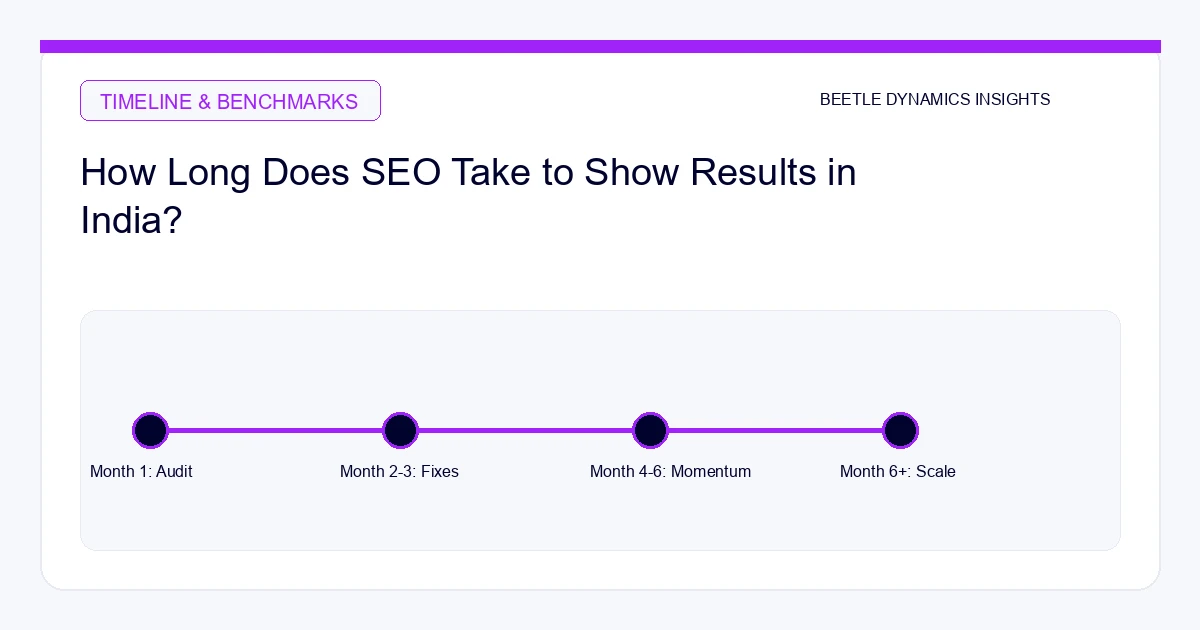
Based on industry data and real campaign observations, here is how SEO results typically unfold for most businesses:

Time PeriodWhat Typically Happens
Month 1–2Technical audit, keyword research, on-page fixes, content planning. Google starts crawling updated pages. Little to no visible ranking movement yet.
Month 3–4Long-tail, low-competition keywords begin to rank. Impressions in Google Search Console increase. You may see a handful of page-2 or page-3 positions appear.
Month 4–6Meaningful ranking movement on target keywords. Some pages break into page 1 for less competitive terms. Organic traffic starts to grow noticeably.
Month 6–9Primary keywords gaining stronger positions. Organic traffic grows more consistently. Leads or sales from organic search become measurable.
Month 9–12Competitive keywords approach page 1. The website builds topical authority. Organic becomes a reliable, growing traffic channel.
12 months+Compounding growth. Rankings stabilise and improve further. Content published in earlier months continues to attract traffic with no additional spend.

The key insight from this table is that months 1 through 3 are often invisible to the untrained eye. Work is being done — technical fixes, content creation, link building — but the Google rankings are not yet moving visibly. This is normal, and it is the phase where many businesses lose patience and stop, right before the results were about to come.

How the Indian Market Affects SEO Timelines

India is not a uniform SEO landscape. A business targeting customers in Tier 1 cities like Mumbai, Delhi, or Bengaluru is operating in a fundamentally different environment than one targeting Tier 2 cities like Jaipur, Indore, or Coimbatore. Here is how that plays out in practice.

Tier 1 Cities: More Competition, Longer Timelines

Searches like ‘chartered accountant in Mumbai’ or ‘interior designer in Bengaluru’ are highly competitive. Dozens of established businesses have been doing SEO for years. In these markets, expect 6 to 12 months before you see consistent page-1 rankings for primary commercial keywords. The work required is heavier — more backlinks, more content depth, more technical precision.

Tier 2 and Tier 3 Cities: Faster Results, Fewer Competitors

In cities like Jaipur, Surat, Lucknow, or Nagpur, search volumes for many business categories are lower, but so is competition. A dental clinic in Jaipur targeting ‘dentist in Mansarovar’ may see page-1 results for local terms within 6 to 10 weeks if the Google Business Profile is properly optimised and citations are in order. This is one of the biggest advantages smaller Indian markets offer — genuine speed in local SEO.

Language and Script Considerations

Hindi and regional language searches (Marathi, Tamil, Telugu, Bengali) present different ranking dynamics. These searches often have far less optimised competition, which means results can come faster — but require specific content and on-page work that many agencies skip. If your audience searches in a language other than English, factor in additional content work.

Mobile-First Reality

India has one of the highest proportions of mobile-only internet users in the world. Google’s ranking algorithm uses mobile performance as a primary signal. A website that loads in 6 seconds on a 4G connection will rank behind one that loads in 2 seconds, all else being equal. Technical SEO for the Indian market must prioritise mobile page speed in a way that is not always emphasised in generic global SEO advice.

SEO Timelines by Business Type

Different businesses have very different starting points and competitive environments. Here is a more specific breakdown.

New Websites (0 to 12 Months Old)

New domains start from zero. Google has no established trust in them, they have no backlinks, and their content history is blank. This is sometimes called the Google Sandbox — a period where new websites tend to rank poorly even when the on-page work is solid. For new websites, expect 4 to 6 months before meaningful ranking movement on anything other than very long-tail queries. Page-1 results for competitive terms typically require 9 to 14 months of consistent effort.

Established Websites with Existing Content

If your website has been live for 2 to 3 years but SEO has never been done properly, you are in a significantly better position than a new site. You have some domain history and possibly some unoptimised content that can be improved quickly. With proper technical fixes and content optimisation, you can often see measurable improvements within 8 to 12 weeks, and strong results within 4 to 6 months.

Local Service Businesses

Doctors, lawyers, dentists, CA firms, home service businesses, and restaurants fall into this category. Local SEO is the fastest-returning type of SEO when done correctly. Google Business Profile optimisation, local citations, and review signals can push a business into the local 3-pack (the map results) within 4 to 10 weeks in mid-competition markets. Organic local page rankings typically follow within 3 to 5 months.

E-Commerce Businesses

E-commerce SEO for Indian businesses — whether on Shopify, WooCommerce, or custom platforms — takes longer because the scope is larger. A store with 500 product pages needs much more technical work than a 10-page service website. Expect 6 to 9 months for strong category-level rankings and 9 to 12 months for consistent organic revenue contribution. The upside: once organic traffic is established for an e-commerce store, the compounding growth effect is substantial. Product pages that rank well continue generating revenue with no additional ad spend.

B2B and SaaS Companies

B2B SEO in India — technology companies, HR software, accounting tools, SaaS platforms — tends to have lower search volumes but much higher deal values. The keywords are often specific and technical. Competition is real but usually not as intense as pure consumer terms. A focused B2B SEO strategy targeting long-tail, high-intent keywords can start generating demo requests or inbound leads within 5 to 7 months.

What Actually Moves the Timeline Faster or Slower

The 3 to 12 month range is a general guide, but specific factors can compress or extend it significantly.

Factors That Speed Things Up

  • Existing domain authority: An older domain with an existing backlink profile will rank new content faster than a brand-new one.
  • Technical SEO done early: Fixing crawl errors, improving page speed, implementing correct schema markup, and resolving indexing issues in the first month removes the barriers that slow Google down.
  • Consistent content publishing: Websites that publish well-researched, genuinely useful content regularly build topical authority faster. Sporadic content does not have the same compounding effect.
  • Earning quality backlinks: A single link from a high-authority Indian news outlet or industry publication can accelerate rankings more than 50 low-quality directory links. Digital PR and editorial link building produce better results in shorter timeframes.
  • Low-competition niche or geography: Targeting a Tier 2 city or a highly specific product niche means less competition and faster results.

Factors That Slow Things Down

  • Highly competitive keywords: Broad terms like ‘digital marketing India’ or ‘best restaurant in Delhi’ take significantly longer than specific ones.
  • Poor technical foundation: Slow loading times, duplicate content, broken internal links, and incorrect indexing settings all hold rankings back and must be resolved before other work can take full effect.
  • Thin or duplicate content: Especially common on e-commerce sites with auto-generated product descriptions. Google does not rank thin pages well.
  • Inconsistent execution: Starting and stopping SEO work is worse than never starting. Rankings built over 6 months can decay within weeks if the work stops entirely.
  • New domain with no history: There is simply no shortcut here. A new domain needs time to establish trust with Google’s systems.

The Realistic Month-by-Month Milestones to Track

Rather than just waiting and hoping, here is what you should actually be measuring at each stage of your SEO investment.

MonthMilestone to TrackTool to Use
Month 1Technical audit complete, critical errors fixed, target keywords confirmedGoogle Search Console, Screaming Frog
Month 2Indexing improving, on-page pages optimised, content calendar liveGoogle Search Console (Coverage report)
Month 3Impressions increasing in Search Console, long-tail keywords appearing on pages 2–5Google Search Console (Performance report)
Month 4–5First page-1 positions for low-competition terms, organic traffic growing 10–30%Semrush / Ahrefs rank tracker
Month 6Primary keywords approaching page 1, organic leads or sales becoming trackableGoogle Analytics 4 (organic channel)
Month 9–12Competitive keywords on page 1, organic becoming a meaningful revenue channelGA4 + CRM lead source tracking

If you reach month 4 and none of these milestones are showing up in your data, something is wrong — either the strategy is off, the execution is inconsistent, or the targets were unrealistic to begin with. You should be seeing Google Search Console impressions growing even if clicks are not yet arriving.

Local SEO vs National SEO: A Different Clock Entirely

One distinction that often gets lost in generic SEO timelines is the difference between local and national SEO. These operate on different clocks.

Local SEO — getting your business to appear in Google Maps and the local 3-pack when someone searches ‘near me’ or with a city name — is driven primarily by your Google Business Profile, local citations, and review volume. These signals respond faster than traditional ranking factors. A well-executed local SEO campaign for a business in a mid-sized Indian city can produce visible results within 6 to 10 weeks.

National SEO — ranking for keywords without any city modifier, targeting an audience across India or internationally — requires building domain authority at a broader scale. This takes longer, typically 6 to 18 months depending on competition, but the audience it unlocks is much larger.

For most Indian service businesses, starting with local SEO and expanding to broader keywords as domain authority grows is the most cost-effective sequence.

Content Marketing and SEO: The Compounding Effect

One of the most under-appreciated aspects of SEO timelines is the compounding nature of content. A blog post published in month 2 does not just rank for one month. If it is well-researched and properly optimised, it can continue to attract organic traffic for 3, 4, or even 5 years.

This is fundamentally different from paid advertising. When you stop paying for a Google Ad, it stops showing. When you stop publishing content, your existing content keeps working. The blog post you publish in January could be driving leads in November of the following year, at zero additional cost per visit.

For Indian businesses specifically, there is an enormous content gap in many industry niches in Hindi and regional languages. Businesses that publish high-quality, genuinely useful content in these languages often find that competition is thin and ranking is significantly faster than in English.

A well-structured content marketing strategy is not separate from SEO — it is one of its most powerful engines.

SEO vs Paid Ads: What Indian Businesses Often Get Wrong

A common mistake in Indian businesses, particularly those that are accustomed to performance marketing, is treating SEO and Google Ads as interchangeable alternatives. They are not.

Performance marketing produces results on day one. You put money in, leads come out. The moment you stop putting money in, leads stop coming out. The cost per lead also tends to increase over time in competitive auction environments because more competitors enter the bidding.

SEO produces nothing in month one. It produces a little in month three. It produces significantly more in month nine. And by month 18 or 24, you have built an asset — a body of ranked content and domain authority — that continues generating traffic and leads whether or not you are actively running campaigns that month.

The businesses that grow most efficiently use both: paid ads to generate leads immediately while SEO builds the organic foundation. Once SEO matures and organic leads are flowing consistently, paid ad spend can be reduced or redirected to new markets.

What Good SEO Reporting Should Show You

If you are working with an SEO agency, monthly reports should include more than just a list of keyword positions. Keyword rankings are a leading indicator, but they are not the full picture. Here is what a transparent report should include:

  • Organic traffic trend from Google Analytics 4 — are monthly sessions growing?
  • Google Search Console impressions and clicks — are more people seeing and visiting the site from organic search?
  • Keyword ranking movement — which target keywords moved up, which moved down, and why?
  • Backlinks earned that month — which sites linked to you, and what is their authority?
  • Technical SEO health — are there new crawl errors, indexing issues, or Core Web Vitals problems?
  • Organic leads or conversions — if tracking is set up correctly, how many enquiries, form submissions, or sales came from organic traffic?

If a monthly report is just a screenshot of keyword positions with no context, no traffic data, and no connection to business outcomes, that is a red flag. Good SEO reporting is transparent about what is working and honest about what is not.

Industries in India Where SEO Timelines Differ Most

Some industries in India have very specific SEO dynamics worth knowing before you set expectations.

Real Estate

Real estate in India is one of the most competitive SEO environments, particularly in Delhi NCR, Mumbai, Pune, and Hyderabad. Large aggregators like 99acres, MagicBricks, and Housing dominate many generic searches. Independent agencies and developers need to focus on highly specific locality-level keywords and content strategies to compete. Expect 9 to 14 months for meaningful rankings in Tier 1 markets. Tier 2 cities are significantly more accessible. Learn more about real estate digital marketing strategies.

E-Commerce

Indian e-commerce faces competition from major marketplaces in search. Ranking for generic product terms against Flipkart or Amazon is extremely difficult. The more effective strategy is targeting brand-specific, category-specific, or problem-specific searches where marketplace dominance is weaker. E-commerce digital marketing timelines range from 6 to 12 months depending heavily on catalogue size and niche specificity.

Healthcare

Healthcare SEO in India falls under what Google calls YMYL (Your Money or Your Life) content — pages that can directly affect a user’s health or safety. Google applies stricter quality standards to these pages. A clinic or hospital website needs to demonstrate genuine expertise, proper author credentials, and factual accuracy. This raises the bar for content quality and means results for highly competitive medical keywords take 9 to 18 months. Local healthcare searches for specific clinics or doctors in specific cities are faster. Read more about healthcare digital marketing.

Education and EdTech

Education searches in India have exploded over the last 5 years. Competition for terms like ‘online MBA,’ ‘best coding bootcamp India,’ and ‘CA coaching near me’ is intense. However, there are enormous long-tail opportunities — specific courses, specific cities, specific exam preparation queries — where well-optimised content can rank within 3 to 5 months. See how education digital marketing differs from other sectors.

A Word on Agencies That Promise Guaranteed Rankings

Any SEO agency that promises you a page-1 ranking by a specific date is not telling you the truth. Google controls rankings. No agency, regardless of size or budget, can force Google to rank a page in a specific position on a specific date.

What a good agency can promise is a clearly defined process, transparent monthly reporting, consistent execution, and a track record of results across comparable businesses and markets. Results in SEO are probabilistic, not guaranteed — but consistent, technically sound work over 6 to 12 months produces measurable outcomes for the vast majority of businesses that stick with it.

The agencies offering guaranteed rankings typically achieve short-term visibility through spammy link schemes that eventually trigger a Google penalty, leaving your site worse off than when you started.

The Bottom Line for Indian Businesses

If you are a local service business in a Tier 2 Indian city, you can realistically expect Google Maps visibility within 6 to 10 weeks and organic page-1 rankings within 3 to 5 months for local keywords. If you are a national e-commerce or B2B business targeting competitive terms, a 9 to 14 month timeline for strong organic revenue contribution is realistic.

The single most important thing you can do is start. Every month you delay is a month of domain authority not being built, content not being indexed, and backlinks not being earned. SEO does not offer shortcuts, but it does offer compounding returns — and those returns are significant when the work is done properly and consistently.

Want to understand where your website stands right now? A proper SEO audit will tell you exactly what technical issues are holding you back, which keywords have realistic ranking potential in your market, and what a realistic timeline looks like for your specific business. Explore our SEO services or get in touch with our team to start with a free strategy conversation.

Frequently Asked Questions

How long does SEO take for a new website in India?

A new website typically needs 4 to 6 months before ranking on the first page for any competitive terms. During the first 3 months, the work focuses on technical foundation, content creation, and initial link building. Visible ranking movement for primary keywords usually begins in months 4 to 6, with significant organic traffic growth following in months 6 to 12. New domains require this ramp-up period because Google needs to establish trust in a site before ranking it prominently.

Can SEO show results in 3 months?

Yes, in some cases. If your website is already established, the technical foundation is sound, and you are targeting low-to-medium competition keywords in a specific city or niche, it is realistic to see measurable ranking movement in 3 months. Local SEO campaigns — specifically Google Maps and local 3-pack visibility — can show results in 6 to 10 weeks. However, ranking on page 1 for broadly competitive national terms in 3 months is not realistic for most businesses starting from scratch.

Why is my competitor ranking higher even though my website looks better?

Website appearance has no direct influence on search rankings. Google ranks pages based on relevance, content depth, domain authority, page speed, technical health, and the quality of backlinks pointing to the site. Your competitor may have been building domain authority for years, has earned more backlinks from relevant sites, or has more comprehensive content addressing the searcher’s query. A proper competitor analysis through tools like Semrush or Ahrefs will show you exactly which gaps need to be closed.

Does social media activity help SEO rankings?

Social media signals are not a direct Google ranking factor. However, active social media marketing helps SEO indirectly by increasing brand visibility, driving traffic to your content, and increasing the chances that journalists or bloggers discover and link to your content — which does directly influence rankings. Treat social media and SEO as complementary, not interchangeable.

How much should an Indian business budget for SEO?

This varies significantly by market, competition level, and business goals. A local service business in a Tier 2 city can see meaningful results with a focused investment at lower monthly retainers. A national e-commerce brand competing across multiple categories requires a more comprehensive scope. The right benchmark is not a rupee figure — it is whether the investment is proportional to the business outcome you are targeting. An SEO programme that generates 30 inbound leads per month should be evaluated against the lifetime value of those leads, not just the monthly retainer cost.

YOU MAY LIKE THIS

1 Comments Text
  • free fire unlimited diamonds cookole says:
    Your comment is awaiting moderation. This is a preview; your comment will be visible after it has been approved.
    Hello, This made things a bit easier to understand, which is honestly rare these days. I’ll probably return here.
  • Leave a Comment

    Your email address will not be published. Required fields are marked *