AEO vs SEO: What Is the Difference and Which One Does Your Business Need?
Search is changing. Google’s AI Overviews, ChatGPT Search, and Perplexity are answering questions directly without sending users to websites. AEO (Answer Engine Optimization) is how you stay visible in this new environment. But does it replace SEO? The short answer is no – and here is what you actually need to know.
For years, the goal of search optimization was simple: rank your page in Google’s blue link results. The higher the position, the more clicks, the more business. This model still works. But search behaviour is shifting.
AI-powered search tools are increasingly answering questions directly in the results page – without a click ever happening. Google’s AI Overviews, ChatGPT Search, Perplexity, and voice assistants are summarizing answers from multiple sources, citing some of them, and leaving others invisible. This is the environment that gave birth to AEO.
What Is SEO?
SEO (Search Engine Optimization) is the practice of optimizing your website so it ranks well in search engine results pages – primarily Google, but also Bing, Yahoo, and others. The goal is to appear when someone searches for a keyword related to your business and earn a click through to your website.
SEO covers three core areas:
- Technical SEO – ensuring Google can crawl, index, and understand your site (page speed, mobile usability, structured data, Core Web Vitals)
- On-page SEO – optimizing the content and metadata on each page for target keywords and search intent
- Off-page SEO – building links and authority signals from other websites that tell Google your content is trustworthy
SEO remains the foundation of organic search visibility. Google’s traditional search still drives the vast majority of web traffic globally, and that is not changing overnight. But the interface through which users access those results is evolving rapidly.
What Is AEO?
AEO (Answer Engine Optimization) is the practice of structuring and formatting your content so it is selected as a direct answer by AI-powered search systems, voice assistants, and featured snippets. Where SEO targets the position in a ranked list, AEO targets selection as the authoritative answer that gets cited or read aloud.
The “answer engines” AEO targets include:
- Google AI Overviews (formerly Search Generative Experience)
- ChatGPT with web search enabled
- Perplexity AI
- Microsoft Copilot
- Voice assistants: Google Assistant, Siri, Alexa
- Google’s featured snippets and People Also Ask boxes
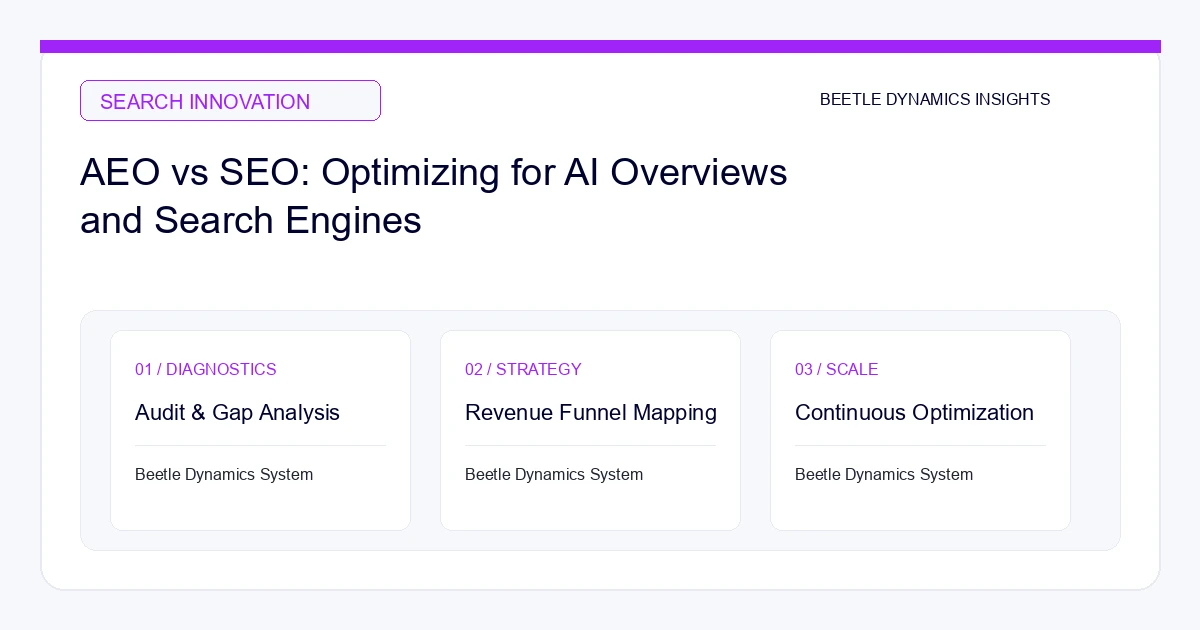
AEO vs SEO: The Key Differences
SEO (Search Engine Optimization)
- Targets ranked positions in SERP blue links
- Goal is to earn a click to your website
- Measured by rankings, organic traffic, conversions
- Requires technical optimization, content, and links
- Works on desktop and mobile web browsers
- Established best practice since the 1990s
AEO (Answer Engine Optimization)
- Targets AI-generated answers and featured snippets
- Goal is to be cited or read as the source answer
- Measured by AI citations, voice search appearances, featured snippet captures
- Requires structured content, clear answers, schema markup
- Works across AI tools, voice assistants, and search
- Emerging practice accelerated by AI search in 2023-2025
How to Optimize for AEO
AEO optimization follows a different logic from traditional keyword targeting. The goal is not just to rank – it is to be the most clear, structured, and credible answer to a specific question. Here is what that looks like in practice:
Structure content around questions and direct answers
AI search tools pull answers from content that directly addresses a question in a clear, concise paragraph. Use question-format headings (H2s and H3s) and follow immediately with a direct answer in the first sentence. This is also what earns featured snippets in traditional Google results.
Use FAQ schema markup
FAQPage and HowTo schema markup helps Google and AI tools identify your content as a structured answer source. Every service page and blog post should include relevant FAQ sections with clean schema markup that lists questions and answers explicitly.
Build topical authority
AI tools cite sources they recognise as authoritative on a topic. Building a comprehensive content cluster around your core topics – with hub pages, blog posts, and detailed guides all interlinked – signals authority to both traditional search and AI tools.
Write clearly and at the right depth
AI tools favour content that answers the question concisely and then provides additional context. The optimal format is: one-sentence direct answer, then 2-3 paragraphs of supporting explanation, then a structured list or table where relevant.
Earn EEAT signals
Google and AI tools weight Experience, Expertise, Authoritativeness, and Trustworthiness heavily when selecting answer sources. Author credentials, case studies, real business information, and genuine expertise signals all improve your AEO standing.
Our content and technical SEO team handles both traditional search optimization and emerging AI visibility. Book a free strategy call.
Is AEO Replacing SEO?
No. This is the most important thing to understand: AEO is not an alternative to SEO. It is an extension of it.
The content that gets cited in Google AI Overviews is almost always content that already ranks well organically. You cannot build AEO visibility on a weak SEO foundation. The link signals, authority, technical health, and content quality that make your pages rank in traditional search are the same signals AI tools use to select answer sources.
What IS changing is that traffic models are shifting. AI-generated answers sometimes reduce clicks to websites (particularly for simple factual queries) while increasing brand awareness and trust for businesses whose content is consistently cited. Understanding this distinction is important for how you measure the ROI of your content investment.
Which Should Beetle Dynamics Focus On?
For most businesses, the priority order is:
- Build strong SEO fundamentals first – technical health, on-page optimization, and quality backlinks. This is the foundation everything else depends on.
- Add AEO elements as a layer – question-format headings, FAQ schema, direct-answer formatting, and topical authority content clusters. These cost very little extra effort and significantly improve featured snippet capture and AI citation rates.
- Monitor AI citation performance – track whether your brand is being cited in Google AI Overviews and AI chat tools for your key topics. This is an emerging metric that will become increasingly important.
The businesses that will dominate search over the next five years are those building genuine topical authority through quality content, strong technical foundations, and clear answer-oriented formatting. Both SEO and AEO reward the same things: expertise, clarity, and credibility.
- Use question-format H2s and H3s throughout your content
- Answer every question directly in the first 1-2 sentences under each heading
- Add FAQPage schema markup to all service pages and key blog posts
- Build content clusters linking hub pages to supporting articles
- Include author bylines and credentials on content pages
- Add structured data (HowTo, FAQ, Article schema) wherever applicable
- Ensure content is mobile-first and loads in under 2.5 seconds
Ready to Optimize for Both?
Build Search Visibility That Works in Both Traditional and AI Search
Book a free strategy call. We review your current SEO foundation and identify exactly where AEO improvements would have the biggest impact on your visibility and leads.