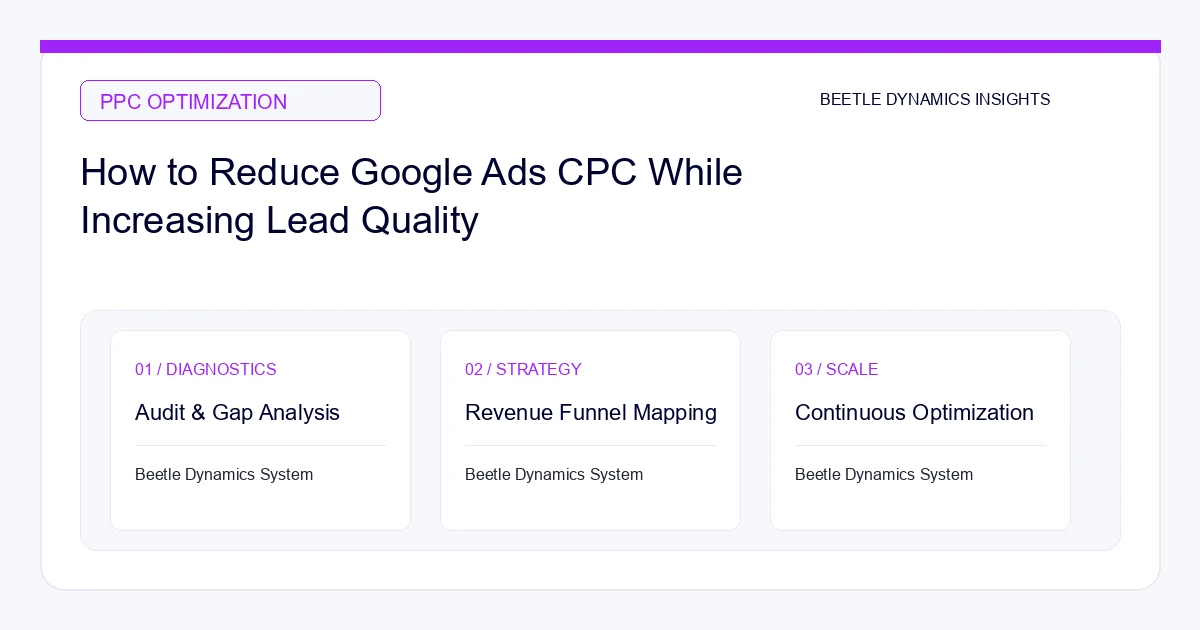
Running Google Ads without controlling your cost per click is like leaving the tap running overnight. The budget drains fast, your cost per lead climbs, and you end up wondering why the campaigns that looked good on paper are performing so poorly in practice.
The truth is that CPC is highly controllable — most businesses overpay not because their industry is inherently expensive, but because their campaigns are structured in ways that drag down Quality Score, attract irrelevant clicks, or burn budget during hours when nobody is ready to buy. Here is how to address each of those issues systematically.
1. Raise Your Quality Score and Watch CPC Drop
Quality Score is Google’s internal rating of how relevant your ad is to the person who triggered it. It affects both your ad position and what you pay. A Quality Score of 8 or above can reduce your CPC by 30–50% compared to a score of 4 for the same keyword position — that’s a significant saving on the same traffic.
Quality Score has three components: expected click-through rate, ad relevance, and landing page experience. To move it upward, your ad text must include the exact keyword the user searched, your headline must directly answer their intent, and your landing page must deliver precisely what the ad promised. Each of these is a measurable thing you can fix.
If someone searches “Google Ads agency for restaurants in Jaipur” and your ad sends them to your homepage, your Quality Score suffers and your CPC rises. Create dedicated ad groups for tightly themed keyword sets and send each to a matching landing page. This one structural change can improve Quality Scores across an entire account within three to four weeks.
2. Build a Negative Keyword List Before You Touch Anything Else
Negative keywords are the most underused tool in Google Ads management. They stop your ads from appearing for searches that sound relevant but will never convert — searches like “free Google Ads course,” “Google Ads salary,” or “Google Ads internship” for a business selling ad management services.
Open your Search Terms report and read it carefully. These are the actual queries triggering your ads, not just the keywords you bid on. Add anything irrelevant to your negative list immediately. Do this weekly for the first month, then monthly thereafter. For most accounts, this exercise alone cuts wasted spend by 15–25% within 30 days.
Start with obvious categories: competitor brand names (unless you’re running conquesting campaigns intentionally), geographic areas you don’t serve, intent signals like “free,” “DIY,” and “how to,” and job-related terms if you’re a service business.
3. Match Types Matter More Than Most Advertisers Realise
Broad match keywords can trigger your ad for searches that are only loosely related to what you sell. Without tight audience targeting and a solid negative keyword list, broad match is a reliable way to spend your budget on low-intent traffic.
Phrase match gives you better control — your ad shows when someone searches your keyword phrase in sequence, with additional words before or after. Exact match is even tighter and typically delivers the highest-quality traffic, though with lower volume. For most campaigns, a combination of phrase and exact match will outperform pure broad match until you have substantial conversion data to train Google’s Smart Bidding algorithm.
4. Schedule Ads for the Hours When Your Leads Actually Convert
Your campaigns are likely running 24 hours a day. But your leads are not arriving 24 hours a day at equal rates. Pull a report broken down by hour of day and day of week — most accounts show a clear pattern where certain time windows produce almost all conversions while others produce mostly clicks that go nowhere.
Apply bid adjustments to reduce spend by 50–70% during low-converting periods. Turn ads off entirely outside business hours if you have no way to respond to enquiries at 2am. This keeps your budget concentrated on the windows where you can actually follow up and convert enquiries into paying clients.
5. Send Ad Traffic to Dedicated Landing Pages, Not Your Homepage
Your homepage is designed for everyone — it explains your whole business. Your ad is targeting someone with a very specific need. Sending ad traffic to a homepage creates a disconnect that raises bounce rates, lowers Quality Score, and increases CPC over time.
Build a landing page for each ad group. It should contain the keyword in the H1, load in under 2.5 seconds, have one clear CTA (no menu, no distractions), and speak directly to the search intent. This single change frequently improves conversion rates by 40–80% while gradually reducing CPC through Quality Score gains.
6. Switch to Conversion-Based Bidding Once You Have the Data
Manual CPC is the right starting point — it gives you direct control while you gather conversion data. But once you hit 30–50 conversions per month per campaign, Smart Bidding strategies like Target CPA or Maximize Conversions with a target can allocate your budget more intelligently than manual management can.
The mistake is rushing into automated bidding before the algorithm has enough data to learn from. Give it 30 days minimum on Manual CPC first, ensure your conversion tracking is accurate, then test Target CPA with a realistic initial target based on your historical cost per lead.
Frequently Asked Questions
What is a good cost per click on Google Ads in India?
This varies significantly by industry. Most service businesses in India see CPCs between ₹20 and ₹150. For a complete industry breakdown, see our guide on Google Ads cost in India 2026. Competitive sectors like finance, legal, and education can reach ₹200–₹500 per click. The number that actually matters is your cost per lead — if your CPC is ₹100 but your conversion rate is 10%, your cost per lead is ₹1,000, which may be excellent for your business.
How quickly can I reduce my Google Ads CPC?
Negative keyword changes take effect immediately. Quality Score improvements take two to four weeks to reflect as Google collects new data. Ad scheduling adjustments apply instantly. If you implement all the changes above systematically, you can expect meaningful CPC reduction within 30–60 days.
Does increasing my budget lower my CPC?
No. Budget size doesn’t directly affect the CPC auction. Bid strategy, Quality Score, and competitor activity determine what you pay per click. Increasing budget without improving campaign quality simply means you’re spending more at the same or higher CPC. Optimise first, then scale budget.
Should I manage Google Ads in-house or hire a specialist?
For small campaigns under ₹30,000 per month, in-house management with proper learning resources can work. Above that level, poor optimisation decisions cost more in wasted spend than you would pay a certified specialist. An experienced agency typically reduces cost per lead by 20–40% through proper campaign structure and ongoing optimisation. To find the right agency, see our guide on how to choose a Google Ads agency in India.
If you want certified Google Ads management for your business in India or Dubai, the team at Beetle Dynamics offers a free Google Ads audit to identify exactly where your current spend is being wasted — before you commit to anything.