Most businesses have spent money on advertising and wondered whether it actually worked. A billboard goes up, a social post gets boosted, a display banner runs for a month, and at the end of it all you are left guessing whether any of those rupees or dirhams did anything useful.
Performance marketing solves that problem completely.
It is a model of digital advertising where you only pay when something measurable happens. A click. A lead form submission. A purchase. An app install. Every rupee you spend is tied directly to a real, trackable outcome. No guesswork. No paying for eyeballs that never converted. Just results you can measure and scale.
This guide covers everything you need to know about performance marketing, how it works, what channels it uses, what metrics matter, and how to get started for your business in 2026.
What Is Performance Marketing?
Performance marketing is a results-driven approach to digital advertising where advertisers pay only when specific, pre-defined actions are completed. Those actions could be a click on an ad, a lead form filled out, a sale made, or a user signing up for a service.
Unlike traditional advertising where you pay upfront for reach or impressions with no guarantee of any return, performance marketing flips the model. You define the outcome you want. You only pay when that outcome happens.
This makes performance marketing one of the most cost-efficient, accountable, and scalable forms of advertising available to businesses today. It sits within the broader world of digital marketing but is uniquely focused on short-term, measurable conversions rather than brand awareness alone.
How Is Performance Marketing Different from Traditional Marketing?
Traditional marketing, think TV commercials, newspaper ads, billboards, and radio spots, charges you for exposure. You pay based on estimated reach or airtime. Whether anyone actually bought from you as a result is almost impossible to verify.
Performance marketing is the opposite. Every action is tracked. Every conversion is attributed. Every channel’s contribution to your revenue can be measured in real time. If a campaign is not delivering results, you can pause it immediately. If one is working exceptionally well, you can scale the budget overnight.
This accountability is why growth-focused businesses across India, the UAE, and globally have shifted their advertising budgets firmly toward performance marketing over the last few years.
How Does Performance Marketing Work?
The mechanics of performance marketing follow a clear, repeatable process. Here is how a typical campaign runs from start to finish.
Step 1: Define the Goal
Every performance marketing campaign begins with a specific, measurable goal. This could be generating leads for a real estate developer, driving purchases for an e-commerce store, getting app downloads for a SaaS product, or booking consultations for a service business. Without a clear goal, there is no way to measure performance.
Step 2: Choose the Right Channels
Different goals suit different platforms. Google Search Ads capture people actively searching for your product. Meta Ads target people based on interests and demographics. Programmatic advertising places your ads across thousands of websites automatically. The right channel mix depends entirely on your audience and objective.
Step 3: Set Up Tracking
This is where performance marketing separates itself from guesswork. Conversion tracking pixels, UTM parameters, and analytics platforms are set up to record every action a user takes after interacting with your ad. Without proper tracking, you cannot measure performance or optimize effectively.
Step 4: Launch and Monitor
Campaigns go live and data starts flowing immediately. Impressions, clicks, cost per click, conversions, cost per acquisition, and return on ad spend are monitored in real time. This data reveals what is working and what needs adjustment.
Step 5: Optimize Continuously
Performance marketing is never set and forget. Ongoing optimization is what separates campaigns that plateau from those that keep improving. Ad creatives get tested. Audiences get refined. Bids get adjusted. Budget gets shifted to the highest-performing combinations.
Step 6: Scale What Works
Once a campaign proves it can deliver results at a target cost, the budget gets scaled. This is the compounding power of performance marketing. Profitable campaigns grow bigger while underperforming ones get cut. Your overall ROI improves as you learn more about your audience.
Key Channels Used in Performance Marketing
Performance marketing runs across a wide range of digital channels. Here are the most commonly used ones and what each does best.
Pay-Per-Click Advertising (PPC)
PPC ads, primarily through Google Ads and Microsoft Ads, appear in search results when users type relevant queries. You pay only when someone clicks your ad. This is one of the most powerful performance channels because it captures users with high purchase intent at the exact moment they are searching for what you offer.
Paid Social Advertising
Platforms like Meta (Facebook and Instagram), LinkedIn, and Snapchat allow you to target highly specific audiences based on demographics, interests, behaviors, and even job titles. Paid social is excellent for both lead generation and e-commerce sales, particularly when paired with strong creative and retargeting.
Affiliate Marketing
In affiliate marketing, publishers and content creators promote your product in exchange for a commission on sales or leads they generate. You only pay when their referral converts. This makes it a zero-risk channel for customer acquisition at scale.
Programmatic Advertising
Programmatic uses automated technology to buy display and video ad inventory across thousands of websites and apps in real time. Targeting is highly sophisticated, and the cost efficiency improves significantly as the algorithm learns which audiences convert best for your campaigns.
Influencer Performance Campaigns
Rather than paying influencers a flat fee for a post, performance-based influencer campaigns pay based on tracked conversions or traffic generated. Unique discount codes and affiliate links make attribution straightforward.
Native Advertising
Native ads appear as editorial content within news sites and content platforms. They blend with the page experience, which reduces ad fatigue and increases engagement. When set up on a performance basis, you pay per click or conversion rather than per impression.
Performance Marketing Pricing Models Explained
One of the defining features of performance marketing is how payment is structured. Here are the most common pricing models you will encounter.
CPC (Cost Per Click)
You pay each time a user clicks on your ad, regardless of whether they convert. Best used for driving traffic to a landing page where further conversion optimization is in place.
CPL (Cost Per Lead)
You pay when a user completes a lead form or takes a qualifying action like signing up for a demo. Common in B2B campaigns and service businesses where the sales cycle is longer.
CPA (Cost Per Acquisition)
You pay when a user completes a purchase or becomes a paying customer. This is the most directly tied to revenue and is preferred by e-commerce and subscription businesses.
ROAS (Return on Ad Spend)
Not a pricing model per se but the primary performance benchmark. ROAS measures how much revenue you generate for every rupee or dirham spent on advertising. A ROAS of 4x means you earn four times what you spent. Strong performance marketing campaigns consistently target and exceed a predetermined ROAS threshold.
CPM (Cost Per Mille)
You pay per thousand impressions. While less typical in pure performance marketing, CPM buying is used in programmatic campaigns where retargeting and awareness play a supporting role in the conversion funnel.
Key Metrics That Matter in Performance Marketing
Knowing which numbers to track is what separates a performance marketer from someone just running ads. Here are the metrics that actually matter.
- CTR (Click-Through Rate): The percentage of people who see your ad and click on it. A higher CTR indicates your ad creative and targeting are well-aligned.
- CVR (Conversion Rate): The percentage of clicks that turn into the desired action. Even a small improvement here dramatically reduces your cost per acquisition.
- CPA (Cost Per Acquisition): How much you spend on average to acquire one customer or lead. Lower is better, but only if quality is maintained.
- ROAS: Revenue earned per rupee spent on ads. The headline metric for e-commerce performance campaigns.
- LTV (Lifetime Value): The total revenue a customer generates over their relationship with your brand. Understanding LTV allows you to spend more aggressively on acquisition while remaining profitable.
- Quality Score: Specific to Google Ads, this affects your ad ranking and cost per click. Higher quality ads pay less for better positions.
Performance Marketing vs Brand Marketing: Do You Need Both?
Performance marketing is brilliant at driving immediate, measurable results. But it works best when combined with brand marketing that builds awareness, trust, and recognition over time.
Think of it this way. Brand marketing warms up your audience. Performance marketing captures them at the moment of decision. A user who has seen your brand multiple times is far more likely to click your performance ad and convert than someone encountering you for the first time.
The most effective performance marketing strategies are backed by strong brand positioning. Neither replaces the other. They work together.
Who Should Use Performance Marketing?
Performance marketing is not just for large corporations with massive ad budgets. It is one of the most accessible and scalable growth tools available to businesses of all sizes. Here is who benefits most from it.
- E-commerce businesses looking to drive online sales with a clear ROAS target
- Service businesses and agencies that need a steady pipeline of qualified leads
- SaaS and app companies targeting sign-ups, trials, or installs
- Real estate developers running lead generation campaigns for property inquiries
- Educational institutions filling courses and programmes
- Healthcare providers attracting patients for specific treatments or consultations
- Local businesses in competitive markets where organic visibility alone is not enough
If your business is based in Jaipur and looking to compete in a crowded local market, working with a digital marketing company in Jaipur that specializes in performance-driven campaigns gives you a significant edge over competitors relying solely on traditional or organic methods.
Common Mistakes Businesses Make with Performance Marketing
Performance marketing done poorly can burn through budget fast. Here are the most frequent mistakes that prevent businesses from getting the returns they expect.
No Clear Conversion Tracking
Running ads without proper tracking is like driving blindfolded. If you cannot attribute conversions accurately to specific campaigns, ads, and keywords, you have no idea what is working. This is the single most common and most costly mistake.
Sending Traffic to a Weak Landing Page
Even the best ad cannot save a slow, confusing, or unconvincing landing page. Your ad and landing page need to be tightly aligned in message, design, and call to action. Improving conversion rate on the landing page often delivers better results than increasing ad spend.
Targeting Too Broadly
Reaching everyone costs more and converts less. Tight audience targeting, focused on the people most likely to take action, consistently outperforms broad campaigns on both cost efficiency and lead quality.
Not Testing Ad Creatives
Running one set of ads indefinitely without testing alternatives is a missed opportunity. Regular A/B testing of headlines, images, copy, and calls to action uncovers combinations that significantly outperform your baseline.
Optimizing for the Wrong Metric
Getting a low cost per click feels good. But if those clicks are not converting, a low CPC is meaningless. Always optimize toward the metric that is closest to your actual revenue goal, whether that is CPA, ROAS, or qualified lead volume.
How to Choose the Right Performance Marketing Agency
Not all agencies that claim to run performance marketing are actually delivering accountable, results-driven campaigns. Here is what to look for when evaluating a partner.
- They start with a thorough understanding of your business goals, not just your ad budget
- They set up and own conversion tracking from day one
- They report on business outcomes, not just impressions and clicks
- They are transparent about what is working and what is not
- They have proven results in your industry or a comparable market
- They continuously test and optimize rather than set campaigns and forget them
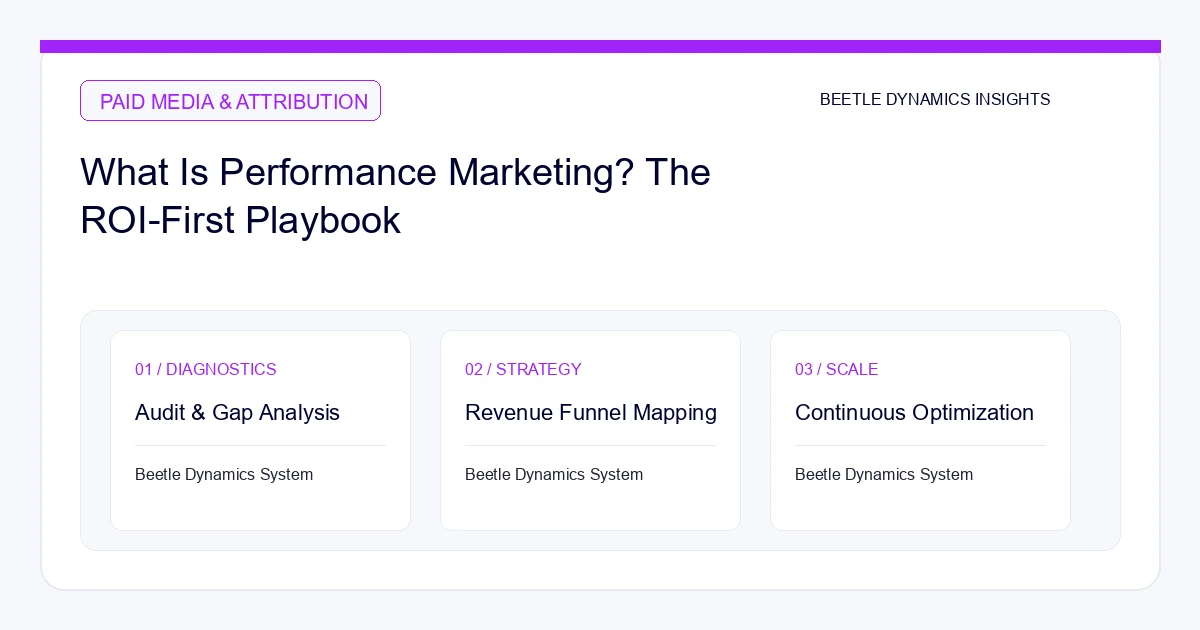
At Beetle Dynamics, our performance marketing services are built around one goal: measurable, scalable growth for your business. Every campaign we run is structured around your conversion targets, tracked meticulously, and optimized continuously to improve returns over time.
Performance Marketing in India and the Middle East in 2026
The digital advertising landscape across India and the Middle East has matured significantly. Mobile-first audiences, rising internet penetration, and increasingly competitive industries have made performance marketing not just useful but essential for businesses that want to grow.
In India, markets like Jaipur, Delhi, Mumbai, and Bangalore are seeing sharp increases in digital ad spend across both B2B and B2C sectors. Businesses that adopt a performance marketing approach gain a measurable advantage over competitors still relying on awareness-only campaigns.
In the UAE and Dubai, where advertising costs are higher and competition for attention is intense, performance marketing’s pay-for-results model delivers the budget accountability that marketing teams and business owners demand.
Whether you are running campaigns domestically or targeting audiences across borders, the principles remain the same: track everything, optimize relentlessly, and scale what works.
Getting Started with Performance Marketing
If you are ready to move beyond guesswork and start marketing with full accountability, performance marketing is where that journey begins. The steps are straightforward.
Start by defining what a conversion means for your business. Set up proper tracking across your website and ad platforms. Choose one or two channels to test before expanding. Build a landing page that is specifically designed to convert the traffic you are sending. Measure results weekly, optimize based on data, and scale campaigns that hit your targets.
None of this needs to be complicated. But it does need to be done properly. Cutting corners on tracking or rushing into ad spend without a conversion-focused landing page are the two fastest ways to waste your budget.
If your business is in Jaipur or serving the Indian market, connecting with a performance-focused digital marketing company in Jaipur that understands local audience behaviour gives your campaigns a significant head start.
Let Performance Marketing Work for Your Business
Performance marketing is not a trend. It is the most accountable, scalable, and data-driven approach to growing your business through digital advertising. In a world where every marketing rupee needs to justify itself, it is the approach that makes the most sense for businesses serious about growth.
At Beetle Dynamics, we have helped businesses across India and the Middle East build performance marketing systems that deliver real, measurable results. From Google Ads and Meta campaigns to full-funnel lead generation strategies, we manage everything end to end.
Talk to our team today and find out how our performance marketing services can drive consistent, trackable growth for your business.